
A Day of Wings, Engines & Questionable Aerodynamic Theories.

Our latest ThamesMOG outing took us to the RAF Museum Hendon, where we traded four wheels for two wings and discovered that early aviators were even braver than anyone who has ever attempted to reverse park a Morgan at a National Trust property. The thought of the forecasted rain and heavy motorway traffic did not deter three ThamesMOGers from taking their pride and joys to RAF Hendon and to join with other Centre members for a full day in the museum.
The exhibitions in six large covered display hangers cover the full range of aircraft, from WW1 up to the ‘90s.
Early Aviation - Blériot & the “Hope This Works” Era
We began among the pioneers, including Louis Blériot, whose aircraft looked suspiciously like something you might knock together in a shed after three pints and a dare. The Blériot XI’s engine appears to have been borrowed from a lawnmower, the wings from a deckchair, and the pilot’s courage from somewhere superhuman. Several members commented that it still looks more structurally sound than a Morgan door hinge.
WWI Sopwiths — When Dogfighting Meant Actual Dogs Might Win
Next came the Sopwiths: Pup, Camel, Snipe. Beautiful, deadly, and held together by string, canvas, and optimism. The rotary engines spun with the propeller, meaning the entire aircraft wanted to turn left at all times—rather like a trad Morgan on a cambered road.

The 1930s — Monoplanes & Streamlining
Into the 1930s we went, admiring the first sleek monoplanes. This was the era when that showed the sudden transition from wire and fabric to aluminium riveted onto streamlined machines. Designers discovered aerodynamics, metal skins, and the idea that pilots might appreciate not being rained on.


WWII Fighters & Bombers — The Icons
The WWII halls delivered the big hitters: At the centre of the exhibition is the Avro Lancaster 'S-for-Sugar' which flew 137 sorties during the war. This is an extraordinary amount as 20 missions was the average to be expected from a Lancaster.

Also on display are the Fairey Battle, Handley-Page Halifax, Airspeed Oxford, Consolidated Liberator, and a Boeing B-17 Flying Fortress. There is a Spitfire, still the most beautiful shape ever to grace the sky, and a Hurricane that dependable workhorse, plus an image of Donald Duck painted on the P-51D Mustang of United States Air Force pilot Donald Emerson during the Second World War.

Engines of the era were equally impressive: the Merlin, the Griffon, and the Twin Wasp - all of which make a modern turbo four sound like a hairdryer.
The Jet Age — Vulcan & the Cold War Thunder

Then came the jets, and the mood shifted from "romantic nostalgia” to “good grief, that’s enormous". The Avro Vulcan dominated the hall like a flying saucer that had decided to go into the nuclear deterrent business. Someone remarked that its delta wing looked like a Morgan Aero 8 drawn by a child with a ruler.
Engines through the Ages — The Real Stars
We lingered over th=e engine displays, admiring: An early Gnome rotaries (basically spinning chaos). WWI Clerget and Le Rhône units. WWII giants like the Merlin. Early jets from de Havilland and Rolls-Royce. The mighty Olympus that powered both the Vulcan and Concorde. Several members were overheard muttering “I wonder if that would fit in a Plus 4”.

Tornado & Harrier — The 80s & 90s Go Fast
The modern era brought us to the Tornado, with its variable sweep wings, and the Harrier, which still looks like it’s breaking the laws of physics out of sheer stubbornness.
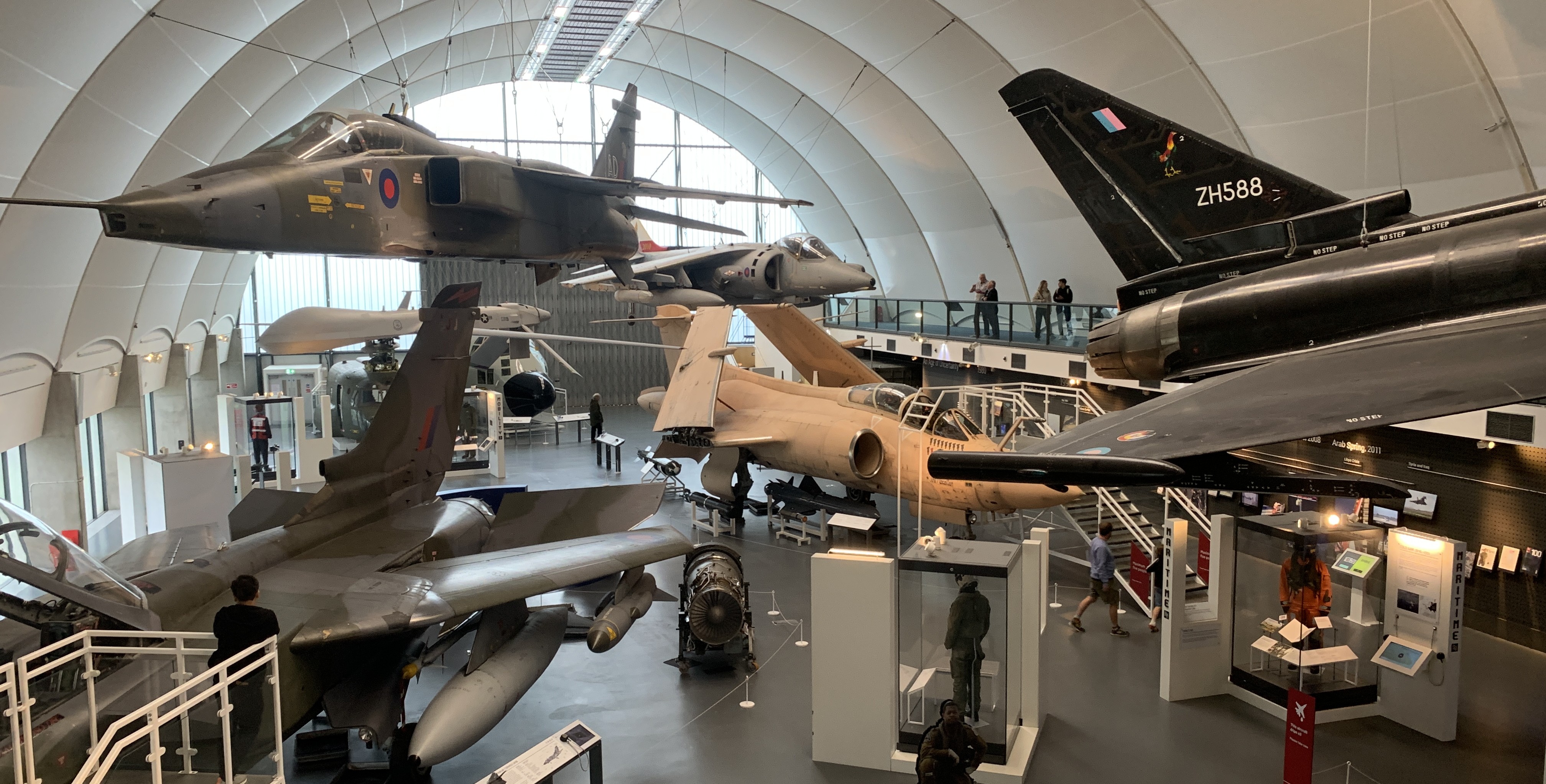
In the ‘modern day’ section, entitled "The Age of Uncertainty" including the Blackburn Buccaneer that bears this noise art. In January 1991 XW547 was prepared for the Gulf War with a few modifications, repainted in the Alkali Removeable Temporary Finish (ARTF), better known as 'desert pink'. She was given the tail code 'R', named The Macallan, and received the nose art 'Guinness Girl/Pauline'. During the Gulf, XW547 took part in 11 missions, after each mission a bomb marking (mission symbol) was added underneath the cockpit on the starboard side that can still be seen on her today.

The Short Sunderland — A Flying Boat We Actually Walked Through
The highlight for many was the Short Sunderland, the majestic flying boat that once patrolled the Atlantic. Hendon’s example is open for visitors, so naturally we all marched aboard like a squadron of slightly confused naval aviators. Inside, you get a real sense of life on long patrols: cramped bunks, narrow walkways, and the lingering feeling that the whole thing is one enthusiastic wave away from becoming a submarine. Several members declared it “surprisingly roomy”, which tells you everything you need to know about Morgan ownership.
Best Regards
Richard Clayton